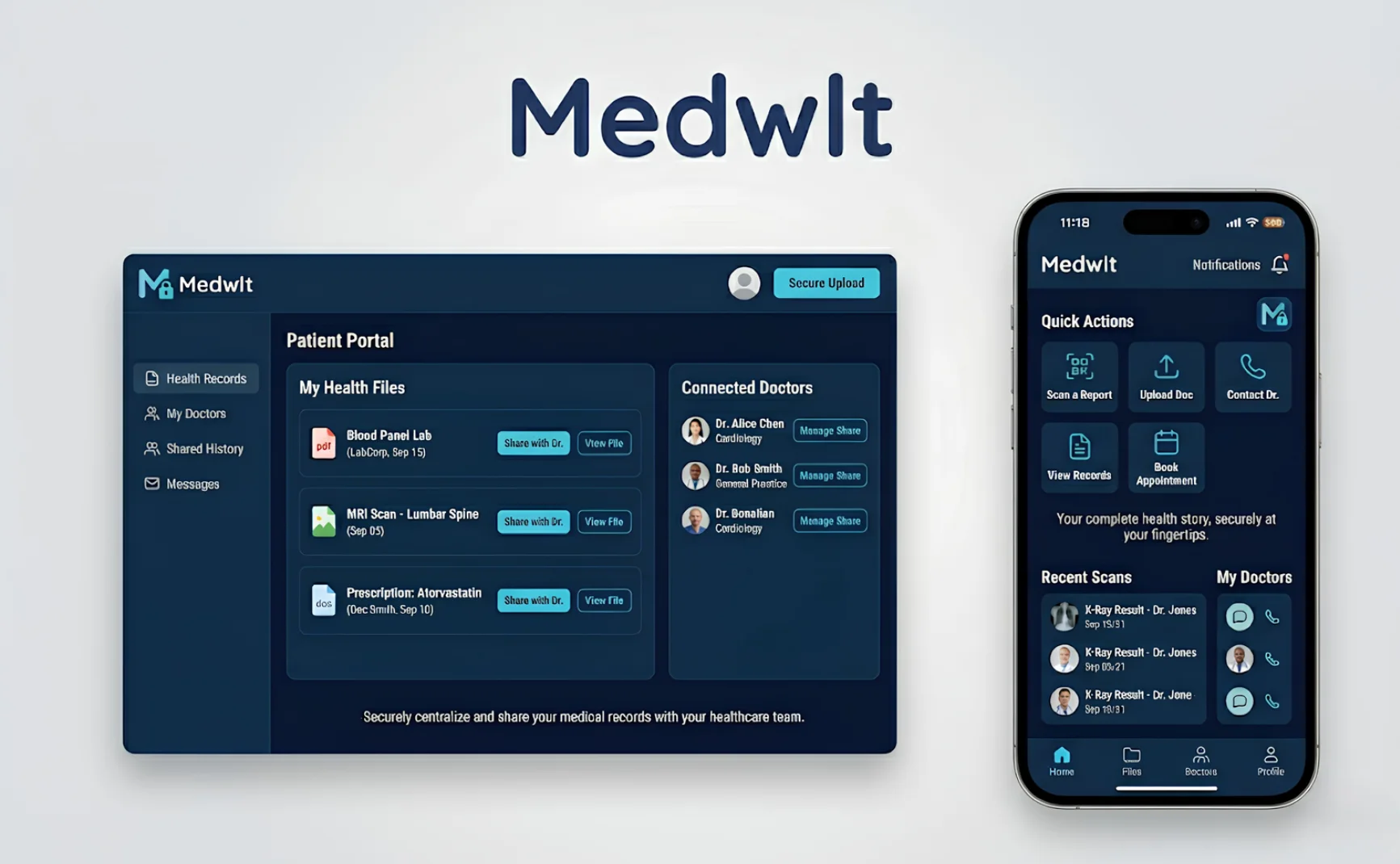
Medwlt Case Study

Architecting a zero-knowledge credential verification ecosystem for healthcare professionals. Built native cryptographic wallets designed to verify identities without sharing raw personal database logs.

Client
Medwlt Inc.
Services
App
Stack
Flutter, Rust
Status
Active
Medwlt Case Study Visual

Medical credential checks have traditionally required scanning and emailing PDF verification sheets. This approach exposes sensitive Personal Identifying Information (PII) like Social Security Numbers and DEA License numbers, presenting significant security risks and compliance headaches. GCAN designed Medwlt to solve this by storing validation details locally under client-side databases and generating mathematically verifiable proofs.

Using client-side Rust compilers running inside Flutter applications, the app generates localized zero-knowledge proofs (ZKPs). Verifiers confirm critical licenses without holding or viewing clinical credential logs, satisfying HIPAA privacy guidelines under a unified schema.

Local Cryptography

Compiles cryptographic proof matrices directly inside client device runtimes.

SQLCipher Storage

Protects off-line database logs with AES-256 memory encryptors.

Healthcare credential verification has historically relied on fragmented manual processes, physical paperwork, and insecure PDF sharing. Clinicians frequently had to expose sensitive Personal Identifying Information (PII)—including DEA numbers, licensing IDs, and national provider registry data—over unencrypted channels, creating significant risks of identity theft and regulatory compliance issues.

Our client needed a secure, enterprise-grade mobile solution that could instantly verify clinician credentials at hospital access points without storing sensitive data on centralized servers or exposing raw licensing logs during checks.

We engineered a native clinical credential wallet utilizing Flutter for cross-platform efficiency and Rust for high-performance local cryptography. Instead of sending raw credentials to the cloud, the application secures them locally using hardware-backed device keys and SQLCipher database encryption.

Verification is achieved via dynamic, short-lived verification codes. Hospital administrators can instantly confirm a clinician's active status via a web-based verifier portal without gaining access to their private underlying data.

Cross-Platform Performance

Flutter front-end coupled with a high-performance native Rust core for rapid cryptographic calculations.

Zero-Knowledge Concepts

Instant verification workflows designed to prove license validity without disclosing underlying sensitive records.

The deployed ecosystem successfully eliminated the bottlenecks of medical onboarding and access control while ensuring absolute compliance with security standards.

< 3s
Verification Time
100%
HIPAA Compliant
95%
Onboarding Reduction

By streamlining the check process from a manual review down to a secure three-second scan, hospital systems achieved massive operational cost savings and improved resource scheduling across shifts.

Native Companion App

Medwlt operates natively on iOS and Android using Flutter. It is constructed around local identity storage concepts to ensure doctors can display validation attributes even when running off-line inside secure hospital basements.

01

Biometric Gateway

Integrates secure system biometrics directly with device key chains to prevent credential access upon loss.

02

Dynamic Verification QR Codes

Generates short-duration validation tokens rendered as rotating QR patterns to prevent duplication attempts.

Medwlt Sync
Dr. Sarah Jenkins
Chief Resident Surgeon
ZKP: 0xef83023...
Active Credentials
DEA Certificate Active
State Board Licensure Active